

Dear Friends,
There’s no question it’s been a tough winter for our area, with continuing drought conditions combined with unusually cold weather challenging everyone in Northern California — but no one more than our valued customers with farms and vineyards.
We’ve been serving the area for close to half a century, and as a family-run local business we truly understand the needs and concerns of our agricultural customers. We sponsor the Frost Alert program and monitor temperatures closely ourselves to ensure that we are prepared to help you when you need us.
This winter, we’ve been working around the clock to help our agricultural customers protect their crops — in addition to propane, we supply tanks, piping and distribution systems for wind machines to keep vines and crops safe from sudden, damaging cold.
Of course, all our customers get our full attention, and with this winter’s frosty temperatures we’ve also been there for residential customers who’ve needed more fuel than usual. It’s kept us busy, but our mission has been and always will be safety and service first. As we all look forward to warmer days and a bit of rain, let us know if we can do anything for you.
Warmly,
Dustin Kaiser
Operations Manager

It’s not easy to find a company that you can count on. If you love the service and value you get from us, why not tell your friends, family or neighbors? They will thank you for the tip.
And we’ll thank both of you: For every friend you refer who becomes a customer, we’ll reward both of you with a discount of 20 cents per gallon on your next delivery.
Make sure your friends give us your name when they sign up and we’ll apply the discount to both your accounts. Contact us today for more information.
We want you to feel good about using propane while knowing that we always have your best interests at heart. With that in mind, here are some tips for staying safe and keeping comfortable. We hope this information gives you more time to relax — and less time worrying.

Shelter from the Storm
With severe storms seemingly becoming the “new normal,” here are some suggestions to help you prepare and stay safe.
- Keep an ample supply of fuel. If you use a backup generator, make sure it has enough fuel. Check the owner’s manual for instructions on calculating how much propane your generator uses. (For generators 9kW or less, it’s approximately 1.5 gallons per hour.) Keep your generator well maintained so it runs properly.
- If your area is prone to flooding, make sure your tank is anchored securely.
- Once the storm passes, check your area for downed power lines, damaged gas lines or damage to your fuel tank. (If it is dark, use flashlights, not candles.)
- Don’t use outdoor appliances indoors and make sure your indoor gas appliances are properly vented.
- Check your appliances for water or other damage. Never turn on a light switch, use a power source or inspect your appliances while you are standing in water. If you think your appliances have been damaged, get them inspected before using them again. Any damaged parts should be replaced right away to ensure continued safe operation.
- If you smell gas, leave your home right away. After only the quickest glance at the on/off knobs on your stove (to see if that’s the source of the problem), open a window or two as you quickly exit the house with your family. Do not smoke or operate lights, appliances, telephones or cell phones. Go to a safe location where you can report the problem to us. You should also call 911 to report the leak.
Where Does Propane Come From
Propane is extracted mainly from natural gas, although it can also be produced from heating up crude oil. Once propane gas is captured, it is slowly cooled until it condenses into a liquid, at which point it is stored under pressure. This is why propane is called liquefied petroleum gas, or LP gas.
Compressed in this way, propane takes up a small amount of space — but delivers a whole lot of energy! When you need propane, it’s released slowly and safely from a valve in your tank and becomes a gas again.
Feel Good about Propane
We’re proud to deliver an environmentally friendly and efficient fuel to your home!
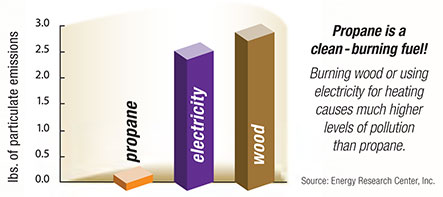
By using propane appliances in your home instead of electric or wood-burning ones, you cut emissions and help preserve the environment. Coal and other fossil fuels need to be burned to create electricity in the first place. And that releases pollutants into the atmosphere. Wood-burning appliances are not nearly as efficient as propane appliances because a lot of the heat generated by the wood gets wasted up the chimney. As a propane consumer, you can feel good about using a fuel that helps to reduce carbon emissions without compromising your comfort.
Do You Have Generator Envy?
All it takes is one power outage and people start getting generator envy — the feeling you get when you see your neighbor’s lights on during a power outage while you’re sitting in the dark. This is making the idea of installing whole-house backup propane generators very popular.
Whole-house propane generators are a better and safer option than noisy, smelly gasoline-powered portable generators. Portable generators provide power for just a few electrical circuits and emit dangerous carbon monoxide fumes. In contrast, quiet whole-house propane generators supply power safely for every circuit in the home, including your heating and cooling systems.
If you already own a generator, follow the tips here to keep your home and family safe.
Safety Tips for Generators
With more and more people relying on both portable and permanent generators than ever before, our team wanted to share the following emergency generator safety tips:
- Installed whole-house generators should have a transfer switch to ensure a smooth transition when the lights go out. A transfer switch cuts electricity flow to the grid while the generator is on. This prevents the power in the generator from “back-feeding” into outside power lines and potentially injuring utility crews.
- Never operate a portable generator in an enclosed or partially enclosed space; keep it outside at least 10 feet from your home and away from windows and doors.
- If your generator is not connected to a propane tank, be sure to store generator fuel in a properly labeled container.
- Always use a grounded extension cord with the proper power rating.
- Have your generator checked and adjusted annually for safety and efficiency.
If you’ve ever run out of gas and we’ve had to perform a pressure check before filling your tank, we may also have done a Gas Appliance System (GAS) Check. But if you’re signed up for automatic delivery, which guarantees you’ll never run out, you may not have had a GAS Check in a while.
A GAS Check is a thorough inspection of your entire propane system that ensures everything is operating safely and efficiently. Our trained technicians will check all lines and connections and look for worn or damaged parts. They also walk you through important safety features of your equipment.
We recommend getting one every year. Any time is the right time for a safety check. Give us a call to set up an appointment today.
Wouldn’t it be nice to know what your propane expenses will be each month? It’s easy. Sign up for our Budget Pay program and you can enjoy manageable, predictable fuel bills by spreading payments out over 12 months. We’ll estimate your annual fuel cost based on your past usage and divide it into 12 equal payments.
You’ll pay one set price all year, making it easier to plan your household budget. Enrollment is open right now! Contact us today for more information.

Q: Why did propane prices go up this year?
A: An unanticipated spike in demand due to colder temperatures across the country, combined with challenges in moving resources — inadequate pipeline capacity and a shortage of rail cars and transit trucks — all contributed to an increase in prices.
Q: Are prices going to stabilize?
A: Yes, this has been a temporary challenge that the propane industry is addressing. The long-term outlook is good for propane prices. Once things get back into balance, prices should return to normal levels.
Come visit us at upcoming shows and fairs this spring and summer. We’ll have camping gear, grills and outdoor equipment to demonstrate. Check out our Autogas fleet!
May 8–11: Dixon May Fair
California’s oldest fair! It’s a classic, with livestock, food, fun and a demolition derby.
July 16–20: Napa Town & Country Fair
Note the new dates — it’s earlier this year to avoid an overlap with the Sonoma fair. Don’t miss us in the parade!
